
Quotation vs Invoice vs Receipt: What's the Difference?
Learn the key differences between a quotation, an invoice, and a receipt — when to use each document, and how all three fit together in a complete business transaction workflow.
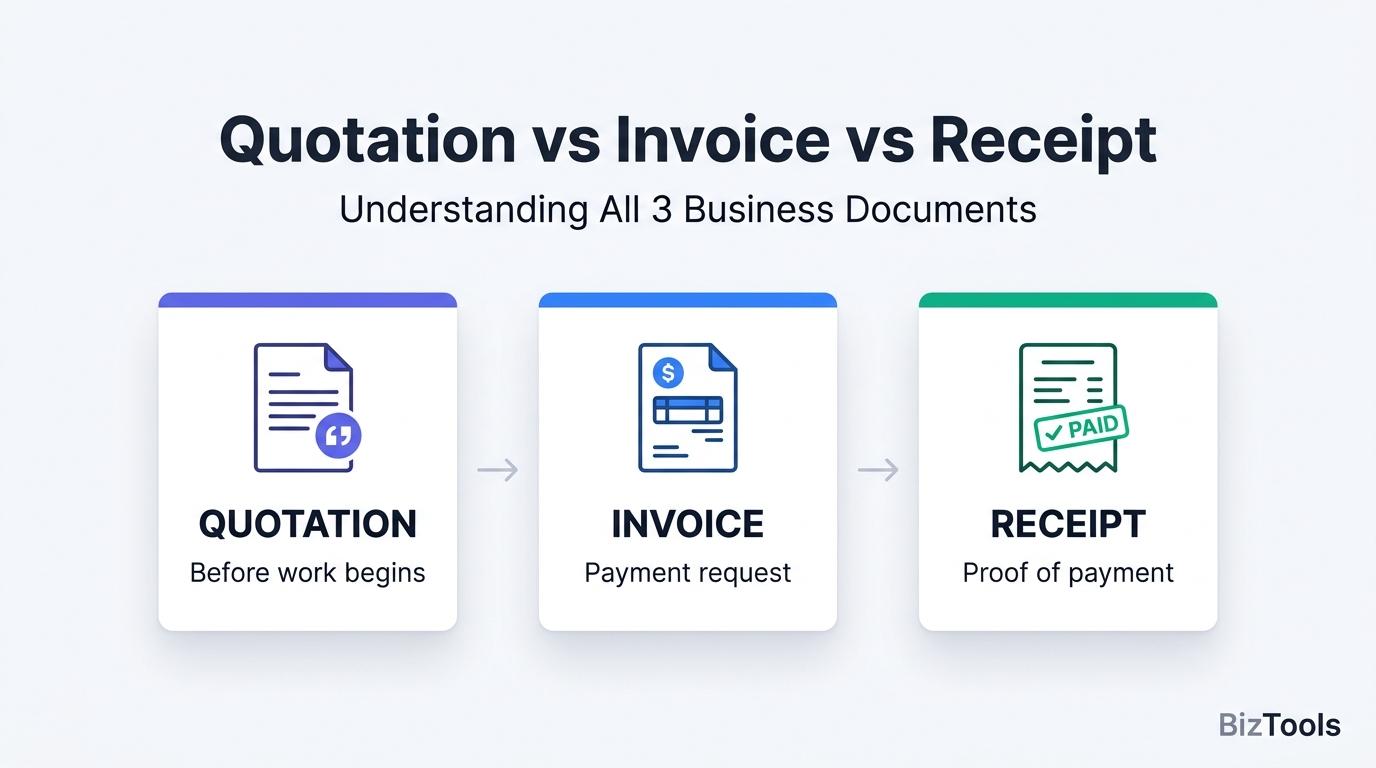
Running a business means issuing the right document at the right time. A quotation, invoice, and receipt are three distinct business documents — each used at a different stage of a transaction. Using them correctly builds professionalism, ensures legal compliance, and keeps your financial records clean.
What Is a Quotation?
A quotation (also called a quote or estimate) is a formal document sent to a potential customer BEFORE any work begins or any goods are delivered. It proposes the cost, scope, and terms of a job so the customer can review and approve.
A quotation is NOT a payment request — it is a price proposal.
Key Details on a Quotation: - Unique quote number (e.g. QUOTE-0001) - Date issued and validity expiry date (e.g. "Valid for 30 days") - Seller and prospective client details - Itemized breakdown of products or services with quantities and unit rates - Applicable taxes and discounts - Payment terms (e.g. 50% deposit required upon acceptance) - Terms and conditions or project scope notes
What Is an Invoice?
An invoice is a formal payment request sent AFTER work is completed or goods have been delivered. It tells the customer exactly how much they owe and when payment is due. It creates a legal payment obligation.
An invoice is NOT proof that payment has been made — it is a demand for payment.
Key Details on an Invoice: - Unique invoice number (e.g. INV-0001) - Invoice issue date and payment due date - Seller and buyer business details - Itemized list of completed work, products, quantities, and unit prices - Applicable taxes and discounts - Total amount due - Payment instructions (bank account, SWIFT/IBAN, payment link)
What Is a Receipt?
A receipt is an official written confirmation that a buyer has completed payment — either fully or partially. It is issued AFTER money changes hands and serves as legally recognized proof of payment.
A receipt IS proof of payment. It documents the settled transaction.
Key Details on a Receipt: - Unique receipt number (e.g. RECEIPT-0001) - Date payment was received - Seller and buyer details - Itemized list of goods or services paid for - Payment method (Cash, Card, Bank Transfer, Online) - Amount paid and any remaining balance - PAID or PARTIALLY PAID stamp
Quotation vs Invoice vs Receipt: Full Comparison
| Feature | Quotation | Invoice | Receipt |
| When Issued | Before work begins | After work is delivered | After payment is made |
| Purpose | Price proposal | Payment request | Payment confirmation |
| Is it a payment request? | No | Yes | No |
| Proof of payment? | No | No | Yes |
| Payment Status | Pending approval | Unpaid / Due | Paid / Partially Paid |
| Legally Binding | Once client accepts | Yes — creates payment obligation | Yes — proves transaction |
| Who Needs It | Client (to approve) | Client (to pay) | Both parties (for records) |
| Followed By | Invoice (after approval) | Receipt (after payment) | Nothing — transaction complete |
The Complete Business Transaction Workflow
The three documents follow a natural sequence in every business transaction:
Step 1 — Send a Quotation Before any work starts, send a quotation outlining your pricing, scope, and terms. The client reviews the quote and either approves, negotiates, or declines. A quotation tells the client: "Here is what I will charge."
Step 2 — Perform the Work Once the client accepts the quotation, complete the agreed-upon work or deliver the goods.
Step 3 — Send an Invoice After delivery or project completion, issue an invoice requesting payment. The invoice tells the client: "The work is done — please pay this amount by this date."
Step 4 — Issue a Receipt Once the client pays (fully or as a deposit), issue a receipt confirming the payment was received. The receipt tells the client: "Thank you — I confirm I received your payment."
Real-World Examples
Example 1 — Freelance Web Designer
- 1Designer sends a Quotation for $2,500 to build a website, valid for 14 days.
- 2Client approves. Designer builds the site.
- 3Designer sends an Invoice for $2,500 due in 7 days.
- 4Client pays. Designer sends a Receipt confirming the $2,500 payment.
Example 2 — Contractor with Deposit
- 1Contractor sends a Quotation for a $10,000 renovation with 30% deposit upfront.
- 2Client pays $3,000 deposit. Contractor issues a Receipt for $3,000.
- 3Work is completed. Contractor sends an Invoice for the remaining $7,000.
- 4Client pays $7,000. Contractor issues a final Receipt for $7,000.
Example 3 — Retail Sale (No Invoice Needed)
- 1Customer walks in, selects items, and pays immediately.
- 2No quotation or invoice is needed — just a Receipt at the point of sale.
Can You Skip Any of These Documents?
- Skip the quotation if payment happens immediately (retail, food service, quick sales).
- Skip the invoice if payment is received upfront at the point of sale — just issue a receipt.
- Never skip the receipt once payment is made — it protects both you and your customer.
Key Takeaway
The simplest way to remember all three:
- Quotation = "Here is what I plan to charge you"
- Invoice = "Please pay me for the work I completed"
- Receipt = "Thank you, I confirm I received your payment"
Using all three documents correctly creates a clear paper trail for your business, reduces payment disputes, simplifies tax filing, and builds trust with your clients.