
Receipt vs Invoice: What's the Difference?
Confused about when to issue a receipt vs an invoice? Learn the key differences between these two essential business documents and when to use each one.
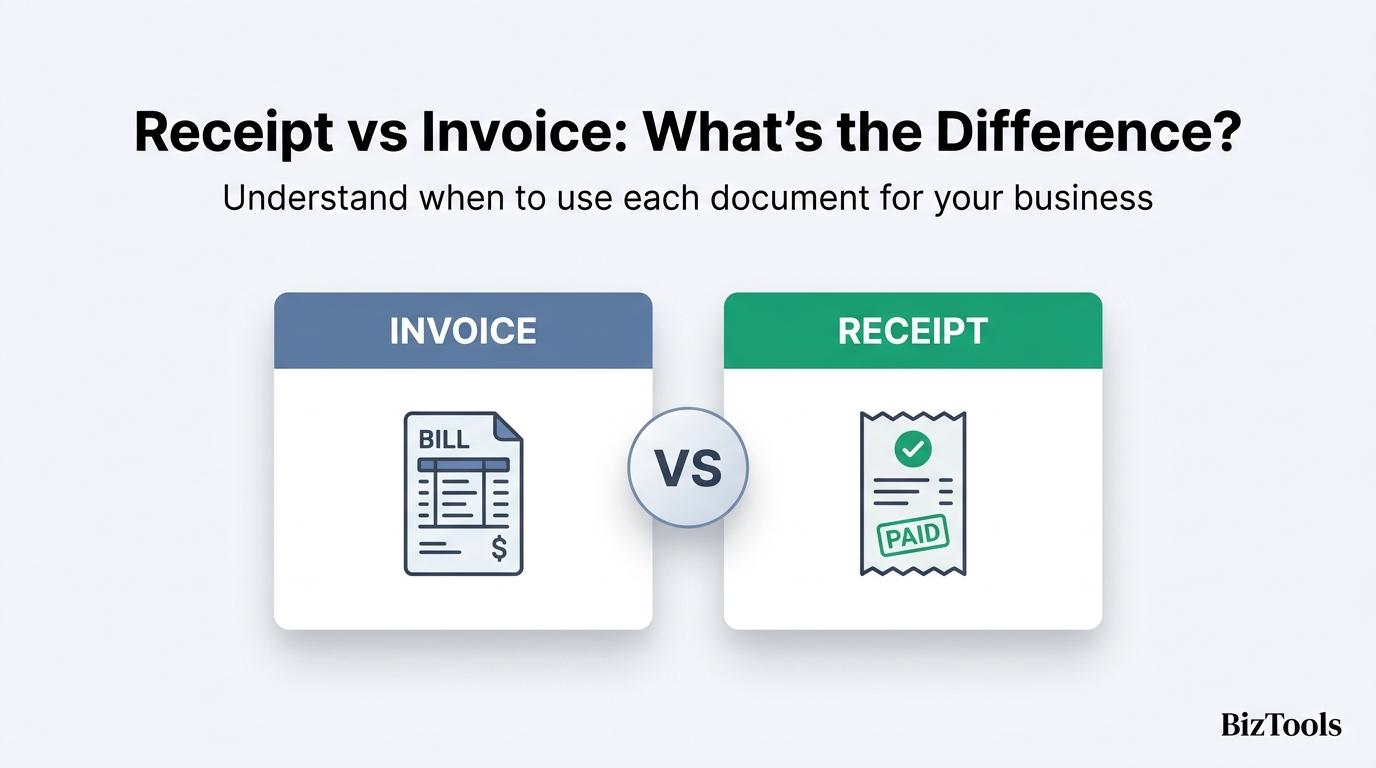
Every business that sells products or services will eventually need to issue either an invoice or a receipt — or both. While both documents record a business transaction, they serve completely different purposes and are issued at different points in the payment process.
What Is an Invoice?
An invoice is a formal payment request sent by a seller to a buyer BEFORE or immediately after payment is due. It tells the customer how much they owe, what they owe it for, and when payment is expected.
An invoice is NOT proof that payment has been made — it is a request for money.
Key Details on an Invoice: - Unique invoice number (e.g. INV-0001) - Invoice date and payment due date - Seller and buyer business details - Itemized list of products or services with quantities and unit prices - Applicable taxes and discounts - Total amount due - Payment instructions (bank details, payment methods)
What Is a Receipt?
A receipt is an official written confirmation that payment has been received and completed. It is issued AFTER the buyer has paid — either in full or in part.
A receipt IS proof of payment. It documents the fact that a transaction is settled.
Key Details on a Receipt: - Unique receipt number (e.g. RECEIPT-0001) - Date payment was received - Seller and buyer details - Itemized list of goods or services paid for - Payment method used (Cash, Card, Bank Transfer, Online) - Amount paid and any remaining balance - PAID or PARTIALLY PAID stamp
Receipt vs Invoice: Side-by-Side Comparison
| Feature | Invoice | Receipt |
| When Issued | Before or when payment is due | After payment is made |
| Purpose | Request payment from buyer | Confirm payment was received |
| Proof of Payment | No | Yes |
| Payment Status | Unpaid / Due | Paid / Partially Paid |
| Legally Binding | Yes — creates payment obligation | Yes — proves transaction occurred |
| Who Needs It | Buyer (to know what to pay) | Both parties (for records) |
When Should You Use an Invoice?
Use an invoice when:
- You have completed work and need to request payment from a client
- You are selling products on credit or net payment terms (e.g. Net 30)
- You need to track unpaid amounts in your accounting records
- You want a legally recognized document to follow up on overdue payments
- You are selling B2B (business to business) where accounts payable processes are involved
When Should You Issue a Receipt?
Issue a receipt when:
- A customer has paid for goods or services in full
- A customer has made a partial or deposit payment
- You are recording a cash sale that doesn't use an invoice
- Your customer needs written proof of payment for expenses, tax deductions, or warranty claims
- You run a retail or service business that takes immediate payment at the point of sale
Can You Issue Both for the Same Transaction?
Yes — this is common practice and recommended for good bookkeeping:
- 1First, send a Quotation outlining your pricing proposal
- 2Once approved, send an Invoice requesting payment
- 3After payment is confirmed, issue a Receipt as proof of payment
Each document plays a distinct role in the business transaction workflow. Using all three protects both you and your client and keeps your financial records clear.
Receipt vs Invoice: Real-World Examples
Example 1 — Freelance Designer A designer completes a logo project and sends an Invoice for $500 due within 14 days. The client pays. The designer then issues a Receipt confirming the $500 payment was received.
Example 2 — Retail Shop A customer buys a product at a physical store and pays cash immediately. No invoice is needed — only a Receipt is issued since payment happens instantly at the point of sale.
Example 3 — Contractor A builder receives a $2,000 deposit upfront for a renovation job. They issue a Receipt for the $2,000 partial payment. When the job is finished, they send an Invoice for the remaining $3,000 balance. After final payment, they issue a final Receipt.
Key Takeaway
The simplest way to remember it:
- Invoice = "Please pay me"
- Receipt = "Thank you, I received your payment"
Both documents are essential for professional business operations. Use invoices to request payment, and receipts to confirm it.